Curated by
September 25, 2021
-
October 30, 2021
Curated by Marian Casey
With works by Fernando Andrade, Richard Armendariz, Joe Harjo, Mari Hernandez, Ethel Shipton, Jose Villalobos, and Anne Wallace
September 25 - October 31, 2021
Opening Reception: Friday, September 25, 2-4pm
with a live performance at 2:30 by Jose Villalobos
Governors Island, Nolan Park 6B
Mutable Land presents artists exploring “Texas” land: how humans change land and the people living on it, focusing on shifting borders, colonization, migration, militarization, gender, and tradition.
Like Governors Island, South Texas carries storied, militarized histories featuring shifting casts of nations vying for control, waging war and redrawing lines on land regardless of people living on it.
Exhibited artists probe experiences of existence in such contested space, throughout history and today, from the battle of the Alamo and forced Indigenous assimilation to contemporary migration experiences and queer life in border towns.
Multiple exhibited artists highlight the histories, spaces, and documents of the changes to control of the land itself, the evolution of how the land was defined, who profited from those evolutions, and who was harmed. In La Frontera 1845 / 2021, Ethel Shipton documents road signs along the former Mexico-U.S. border of 1845, the Nueces River. In her works The Signing and Plotted Brother Against Brother, Mari Hernandez uses her own body to poke fun at the heroicized, idealized history of the Texas Revolution, The Alamo, and the confluence of aggressive masculinity and imperialism. Earlier in the history of Texan colonialism, on her Naming Stones Anne Wallace engraves the names of Indigenous tribes and bands affiliated with San Antonio’s history on antique building limestones, a material similar to that of the Spanish Colonial Missions — missions largely built by enslaved Indigenous people. In The Unofficial Story, Wallace explores changes to place and displacement on a smaller, more local scale: Wallace interviewed longtime residents of Lavaca, San Antonio’s oldest neighborhood, residents who remember Lavaca before urban renewal and gentrification. She then used a self-developed movable typesetting system, inspired by concrete makers’ marks, to stamp their stories into neighborhood sidewalks, connecting the past and present of a changing city for all who walk through it. Prints of the public works are accompanied by an 1890s-era piece of sidewalk stamped by George G. Braden, a pioneering sidewalk contractor, just one of many reminders of labor history one can spy while moving around one’s city.
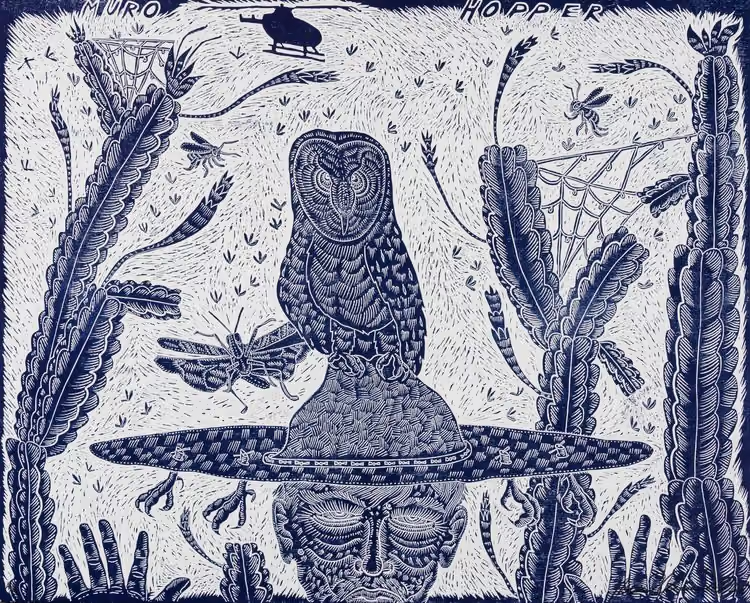
Other works explore the experience of movement across South Texas and the U.S.-Mexican border: In El Otro Lado, Anne Wallace knits together human and wildlife voices of the border, revealing the site as a projection of our fears, desires and politics. Fernando Andrade emphasizes the importance of the roads that serve to connect us, inspired by reminiscing about stories told by his grandmother about her travels across Mexico and Texas to visit family. In Muro Hopper, Ricky Armendariz references curanderos, traditional Indigenous healers who don’t recognize borders and who once moved more freely across the Texas-Mexico border to practice; a movement severely affected by stringent security measures and border politics. The work also speaks to family separation at the border and the adverse ecological impact of border barriers.
Some exhibited artists explore the way existence on such contested land affects the generational transformation and contemporary experiences of the people themselves: in Tell Me Where It Hurts, Ricky Armendariz continues his borderland animal motifs, this time to represent a childhood memory of visiting the doctor. Raised in a machismo environment to not show vulnerability, the central figure reflects the apprehension and discomfort at admitting to pain. Jose Villalobos also grapples with toxic masculinity and machismo, having grown up in a traditional, conservative family on the border in El Paso. His work reconciles the identity challenges in his life, caught between traditional Mexican customs and American mores, as well as growing up with religious ideals that conflict with being gay. Mi Ser also traces the history of queer Bracero workers (seasonal migrant laborers participating in the federal Bracero Program) — in particular, one queer Bracero worker, Porfirio — as a way to combat historical erasure and empower queer voices. Finally, Joe Harjo explores how Indigenous people have been treated by colonizers through history and how they continue to be perceived: The Only Certain Way series speaks to the forced assimilation of Indigenous Peoples to Christianity, referencing 16th century Spanish explorer and conqueror Álvar Núñez Cabeza de Vaca quote saying that Indians “must be won by kindness, the only certain way.” The series highlights historic and contemporary dismantling of tribal identity, drawing a connection between religious notions forced upon Natives, the resulting adaptation of non-Native customs, and subsequent crises of identity, whitewashing of culture, and removal of access to ancestors and their omnipresent spirits.
About Marian Casey:
An independent curator, Marian’s curatorial practice focuses on social engagement and building experimental approaches to historic narratives and spaces; she sees the potential in curating as an experimental mediator between contemporary art and relevant histories, socio-political contexts, and communities. Curating primarily in New York and London, she is especially driven to curate projects promoting women and LGBTQ+ artists and stories.
Marian received an undergraduate degree in art history from the University of St Andrews and a graduate degree in curating from the Courtauld Institute. Marian has worked with curatorial teams at The Metropolitan Museum of Art, The Courtauld Gallery, The Royal Academy, and Times Square Arts, among others. mariancasey.com