Starting in 2023, one US based applicant per season of the International Residency will be awarded a Full Fellowship, which covers all program fees for the season. A jury consisting of NARS staff and select art professionals review applications on the merit of artistic quality and level of need; studio practice; and the potential professional development and benefit from engaging with the NARS community. Only US based artists are eligible to receive the Full Fellowship.
Click here to learn more about the International Residency Program, and how to apply.
Xinan Helen Ran is a multidisciplinary artist who creates installations and public art encounters, using collapsible materials such as fabric, text, natural elements and found objects. Her work explores the intersections of trade, waste disposal, labor, leisure, and homemaking in the new world. Xinan is drawn to the point where trauma, nihilism, and humor converge.
Based in Brooklyn, Xinan creates portable installations and public art encounters. Ranked “Highbrow and Brilliant” by New York Magazine’s Matrix (2023), she is a 2025 MacDowell Fellow, a 2025 NARS Foundation Fellow, a 2024 More Art Commission Artist, and a 2024 NYSCA grant recipient. She was a resident at the LMCC Arts Center (2022), and an Ox-BowFellow (2016). Exhibiting nationally and internationally, Xinan has collaborated on public projects with the Harvard Peabody Museum of Archaeology(Cambridge, MA), Stone Quarry Art Park (Syracuse, NY), and Beam Center(Governors Island, NY). Xinan is an art educator, an art administrator, and as et designer for new theaters.
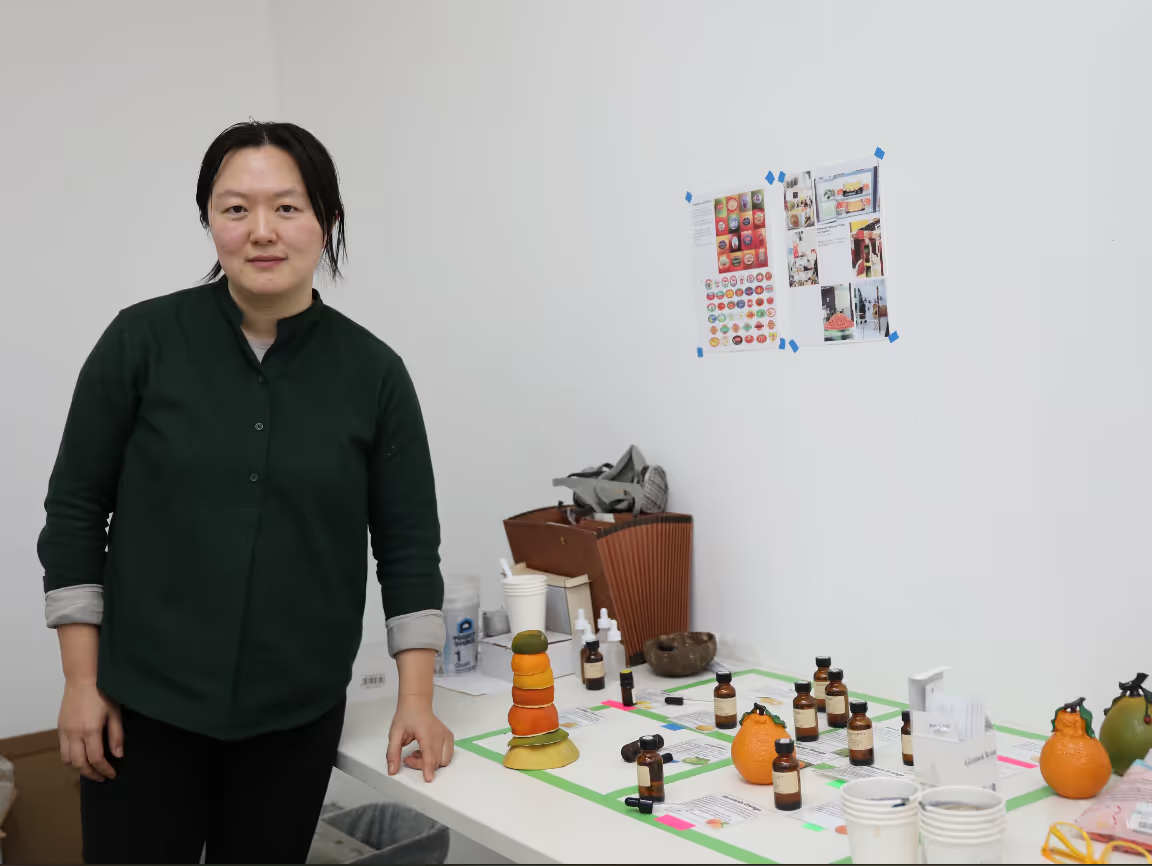
I’m a Brooklyn-based artist working across installation, sculpture, and public space. I’m particularly interested in developing systems and processes that allow a work to occupy a large space while still being collapsible and compact for storage. Portability has become a guiding principle in my practice, shaped by years of moving around New York and maintaining a storage unit. During my time at NARS, I focused on developing The Mandarin Project, which explores the parallel timelines of Mandarin as a language and Mandarin as an orange.
I’m feeling invigorated after three months of studio time at NARS. I’ve met and exchanged ideas with many visitors, writers, and friends, and I’m really looking forward to upcoming workshops, engagements, and performances in early 2026, that have stemmed from these three months’ of work.
I tend to resist rigid routines and instead let ideas, encounters, and events guide my day as they arise. My studio days usually start around noon and might include a studio visit or focused work on project outreach. Having a dedicated studio space allowed me to concentrate during hours when I don’t usually consider myself productive.
Slavs and Tatars, Martin Roth, Paul Ramírez Jonas, Aki Sasamoto, and Mika Rottenberg. I’m drawn to work that can be experienced by a wide range of audiences, revealing different levels of complexity depending on the time and attention one brings to it. These artists’ practices unfold across multiple layers of intention and meaning.
This was my first time having a studio separate from my living space since graduate school three years ago. What surprised me most was how profoundly helpful a dedicated studio has been—not only in creating room for experimentation, but also in enabling me to invite visitors into a space that fully represents the breadth of my practice.
I especially enjoyed ASAP and the exhibition process, working closely with my cohort and the curator. NARS is very thoughtful in creating time and structures for fellows to learn from, connect with, and support one another. This emphasis on peer exchange is a unique and valuable aspect of the residency, and something that’s often overlooked in other programs.
I spent the early stage of the residency focusing on outreach and research, and experienced a real breakthrough after that first month. I now feel much more confident about bringing my work-in-progress to strangers and inviting others to engage with it through studio visits. In addition to visitors coordinated by NARS, I organized many more studio visits with artists, scholars, and creatives across disciplines—something I hadn’t previously tried as part of project development.
After finishing my MFA, I worried that a lack of community might affect my ability to share works-in-progress. Through these visits and conversations at NARS, that concern has faded. I now feel equipped to cultivate these exchanges on my own.
This residency clarified for me the importance of having a studio space separate from one’s home. It’s not just a place to make a mess, but a space that fosters intention and allows work to linger and develop on its own terms. I’m also taking with me a deeper understanding of why—and how—outreach beyond one’s immediate circle is essential during a project’s development.
It’s interesting to observe how international artists experience relocating for three months, compared to fellows who already have established relationships with the city and neighborhood. I’d encourage future fellows to articulate their intentions and goals early on, revisit them throughout the residency, and consciously shape their daily lives around those priorities.
.avif)