Starting in 2023, one US based applicant per season of the International Residency will be awarded a Full Fellowship, which covers all program fees for the season. A jury consisting of NARS staff and select art professionals review applications on the merit of artistic quality and level of need; studio practice; and the potential professional development and benefit from engaging with the NARS community. Only US based artists are eligible to receive the Full Fellowship.
Click here to learn more about the International Residency Program, and how to apply.
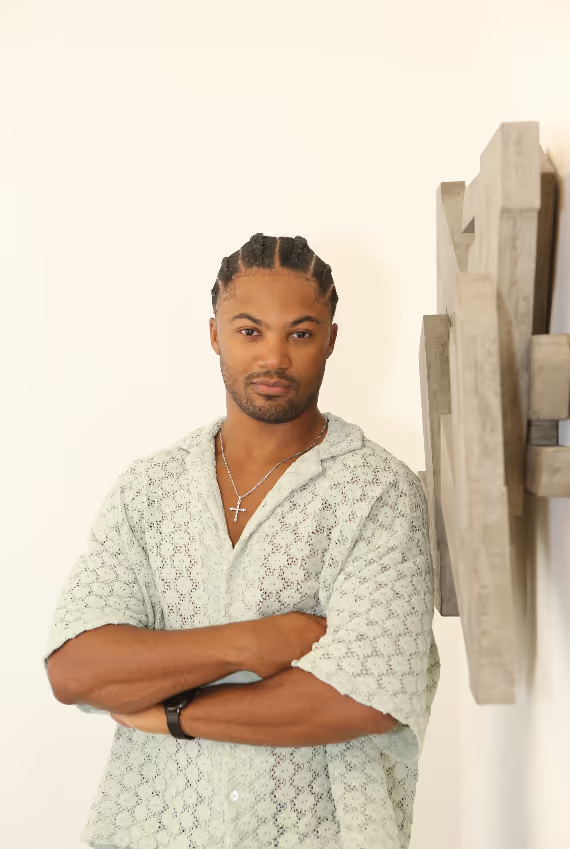
Jayden Ashley explores the vacuum between Black experiences and external perceptions of Blackness. He invokes Black history and collective memory, following the threads that connect them to the present. Ashley challenges conventions of legibility and literacy with language and iconography to provoke viewers to question their unconscious biases about race. His visual language incorporates a wide range of urban materials, resulting in sculptures rich in symbolism that interrogate the racial evocations embedded within materiality. Ashley’s work instigates a forced confrontation between viewers' conscious and unconscious perceptions of and relationship with Blackness.
Born and based in Brooklyn, NY, visual artist Jayden Ashley (b. 2002) explores the vacuum between Black experiences and external perceptions of Blackness. Ashley has been an artist-in-residence at multiple programs around the world, including the Wassaic Project in Wassaic, NY (2025), Foundation House in Greenwich, CT (2024), and Casa Belgrado in Buenos Aires, Argentina (2023). Notable group exhibitions include Threaded Visions at BWAC Gallery, Brooklyn, NY (2025) and Crossing Points at Galeria Azur, New York, NY (2024). Ashley is also a recipient of the Colin Chase Fellowship Fund from the Vermont Studio Center.
My name is Jayden Ashley (he/him). I'm born, raised and based out of Brooklyn. My work focuses on erasure and it's links to targeting historically marginalized communities through gentrification practices, like redlining. I reference sectors from the Home Owners' Loan Corporation’s (HOLC) Residential Security Maps, where the color red was used to mark neighborhoods as “hazardous.” Areas once bordered to designate Black presence as undesirable are now aggressively targeted for urban development and gentrification. My recent cement compositions reflect on how borders, geography, and material transformation perpetuate systemic violence against Black communities—from neglect to displacement.
I come in, flick on the light, and immediately turn on the fan. A lot of my process is digital- I'm working with maps; specifically the shapes of neighborhoods. Cutting these shapes out of wood, it's a lot of woodworking. Those are my favorite days; I put on music and zone in. I can turn off part of my brain, just cut for hours and not really think about much. Which, for me, is exciting.
The conceptual part is the heavy lifting, the execution is the easy part. Once I decide like what I'm making, there's no going back. I'm just going to finish it and see what happens.
In the studio, I'm usually listening to RnB or rap, but I'm half Jamaican, so today I was listening to Dancehall. I don't work on the pieces on the wall, I work on them flat on the table, so they become these sort of topographical maps. It can feel almost dystopian, stacking building atop of buildings. What happens when all the neighborhoods are filled with vacant buildings?
I'd say Theaster Gates' Dirty Red (2016) had a huge impact on my practice. I was compelled by the idea of presenting this object that is supposed to save lives, to protect people and their homes; the same tool that had been weaponized against Black people during the Civil Rights movement. It taught me how a material can be conceptually, politically, and socially charged. I felt different connections to the fire hose as a structure, an object, as a material. I loved the way they functioned as a canvas where you could read their history.
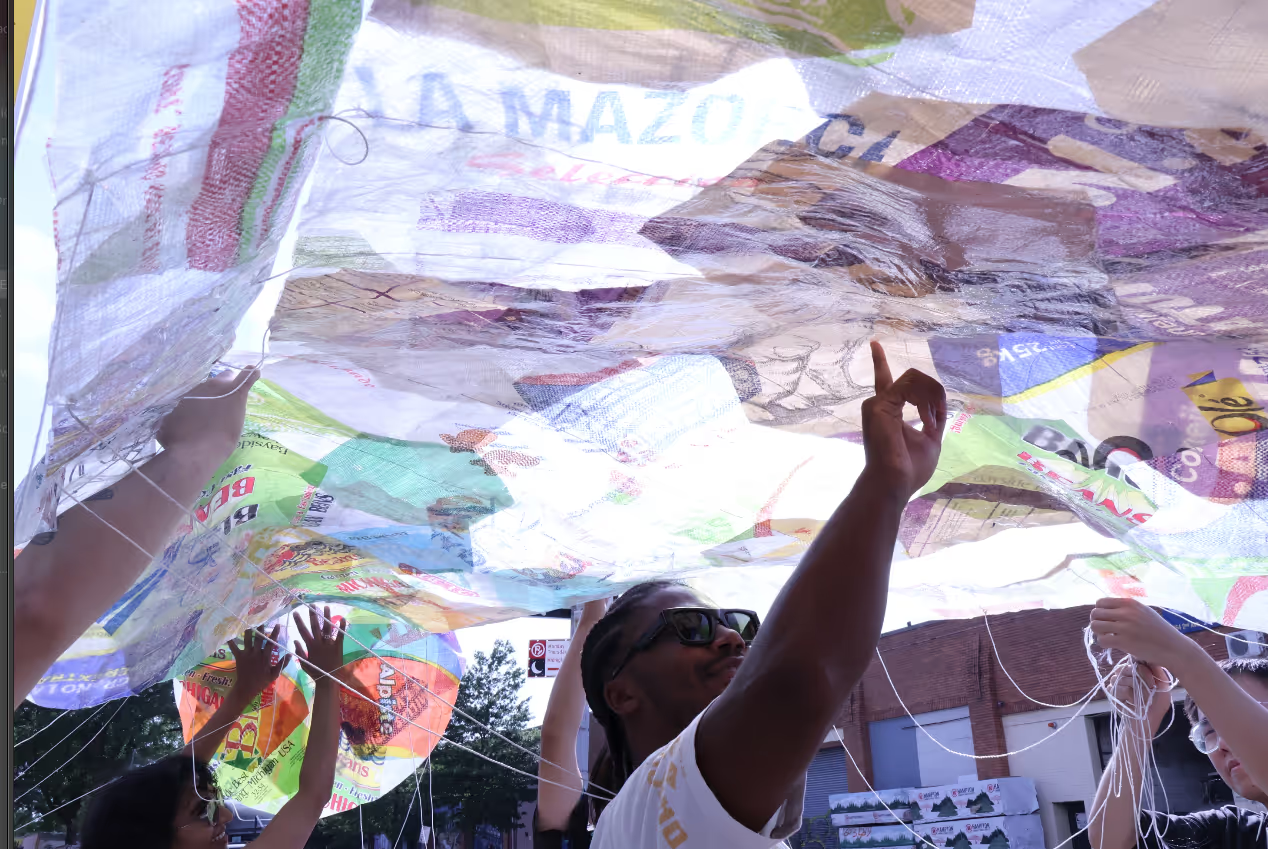
In my practice, it led me to think about the usages of fire hoses in New York City, their contribution to the rapid gentrification of the city. In a demolition, the Fire Department will use fire hoses to soften the materials of the home. I use the fire hydrant imagery as a symbol of Black Culture in New York City, as it relates to block parties and community gatherings. Ive been using fire hydrants in my practice to explore the erasure of our culture through gentrification and urban development.
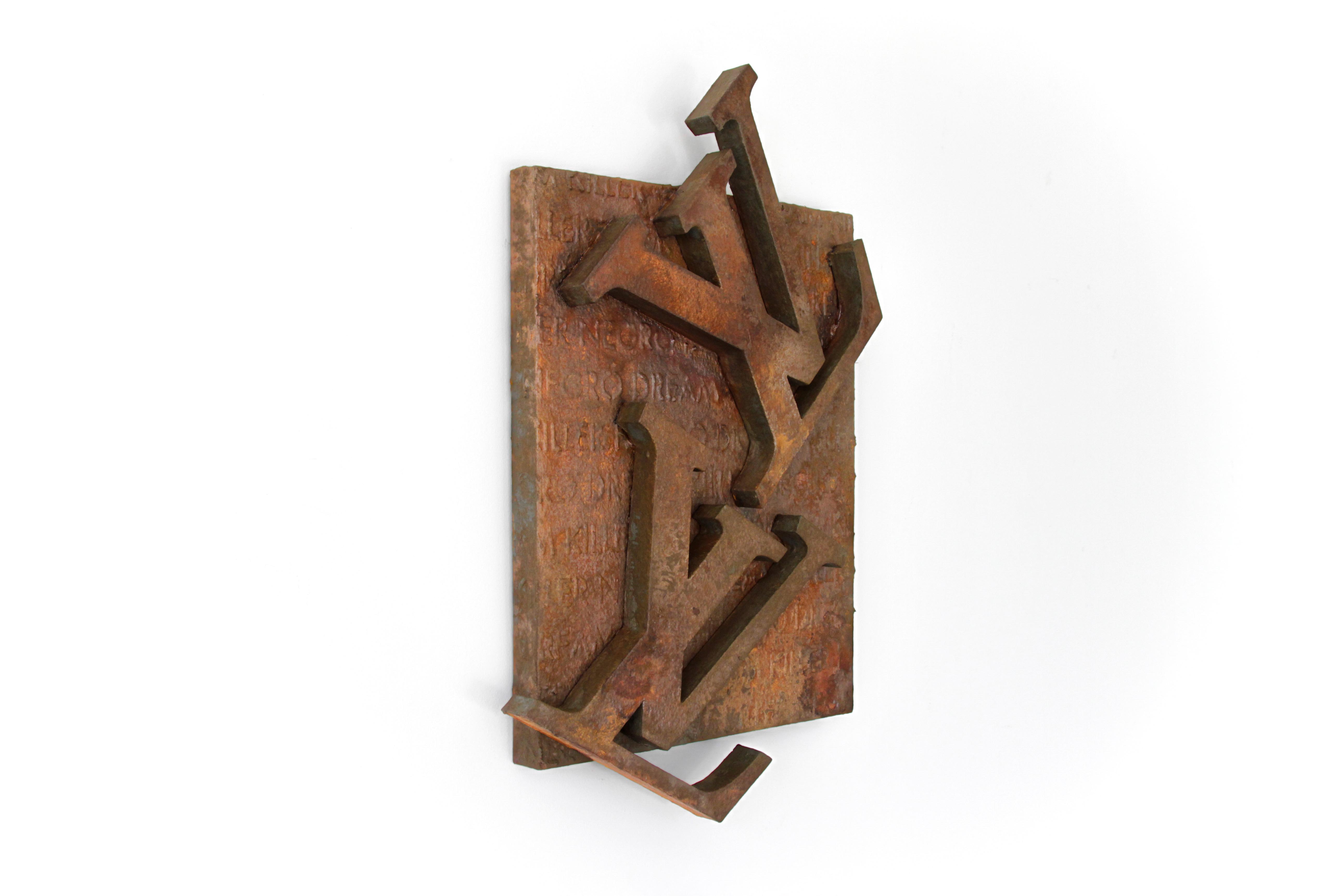
My older work is text based via oil painting, which led me to desire more dimensionality from the material. I found oil too literal, too functional, something about it was a little bit too easy to digest. I wanted something more interesting for my practice and the viewer. I began to work with metal which interested me in the ways it provides information while concealing, sending the viewer on a journey– searching for the information. My works are an intense process of reduction until I reach the core necessity of the work. I do not like to explain my work.
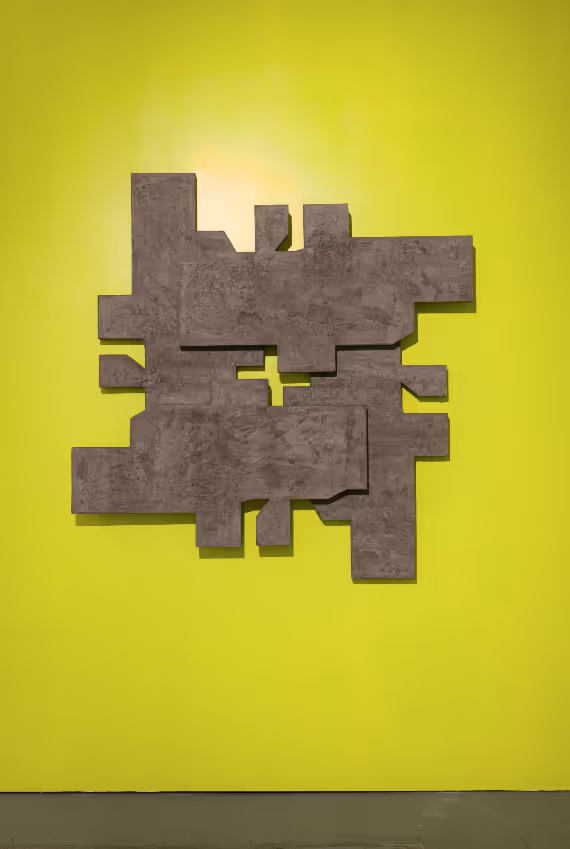
The shapes are NOT abstract, they are very specific sectors on maps. So it feels like the same sort of process. I'm taking this shape that already exists and duplicating it. To the viewer, it may seem abstract. Through repetition, they do become abstracted to a degree. I have always been drawn to repetition. In the work I showed in the NARS exhibition, ‘No Letting Go,’ it feels like I'm magnifying or scaling up the violent act of gentrification [of Harlem]. Several times, and in four different directions.
The language of gentrification is repetition: high-rise buildings erected one-after-another. It's sneaky, sometimes it comes in waves, or sometimes you blink and your surroundings have changed. Sometimes you wake up and you don't recognize where you are.
I think its a combination of both. Some people look at the works and immediately recognize the casts. But then they become something else-- a hollow relic of what was once there. When you cast something in concrete, it becomes a more interesting, ghostly material. Something of a tombstone, an object meant to hold memory.
I've seen so many homes torn down on my block, cultural centers, small businesses, things that are impactful to the people who live in the community. I've watched neighbors be displaced, no longer able to afford rent in the community they grew up in.
Having the chance to connect with other artists and just be in each other's presence, contributing to one another's growth. Iron sharpens iron.. So being around eleven incredible artists was the most important part. I formed some really strong connections here, and we even created another group show during our time at NARS. I am going to miss the openness, and the collaborative nature of the cohort. It's going to be hard to probably find that again in another program. It's just such a rare, beautiful experience.
Be friendly. Talk to your fellow residents, go to shows together, be present when you're with them and and I think beautiful things will grow from that. It's New York City, there's always something to do. Just make the most out of all the resources you have here. See all the art that the city has to offer. But, you know, don't do it alone.